Local Runtime Evidence
The AWS activation path remains intentionally unexecuted, but the platform now also has real runtime evidence from a disposable local Kubernetes environment. This closes the gap between static CI and cloud provisioning without implying that an EKS account exists.
Runtime environment
Evidence below was captured on 22 September 2026 from:
kindclusterplatform-local;- Kubernetes v1.36.4;
- Argo CD reconciliation;
- Kyverno admission enforcement;
- kube-prometheus-stack / Prometheus;
- Trivy Operator;
- Falco modern eBPF;
- VPA in recommendation-only mode;
- OpenCost connected to the in-cluster Prometheus service.
The sanitized command transcript is stored at docs/evidence/local-runtime-2026-09-22.txt.
GitOps reconciliation
Nine applications were Healthy / Synced during the capture:
| Argo application | Runtime state |
|---|---|
platform-demo |
Healthy / Synced |
platform-security-policies |
Healthy / Synced |
metrics-server |
Healthy / Synced |
vertical-pod-autoscaler |
Healthy / Synced |
opencost |
Healthy / Synced |
cost-controls |
Healthy / Synced |
cost-monitoring-resources |
Healthy / Synced |
reliability-resources |
Healthy / Synced |
reliability-monitoring-resources |
Healthy / Synced |
This is evidence from the local kind runtime. It is not evidence of Argo running in EKS.
Signed-image and admission enforcement
The local namespace enforces the Kubernetes restricted Pod Security profile and the project Kyverno policies. Three server-side dry-run requests isolate the supply-chain controls:
- the immutable project image
ghcr.io/fadyy2k/platform-demo@sha256:5fc1...89dbwas admitted; - the mutable project tag
ghcr.io/fadyy2k/platform-demo:latestwas denied byvalidate-platform-demo-images; - a syntactically valid but unknown digest in the project repository was denied by
verify-platform-demo-signaturewhen the registry manifest/signature could not be verified.
The admitted digest is the same digest signed keylessly by the trusted GitHub Actions workflow identity.
Prometheus, SLOs and error-budget behavior
Prometheus reported 14/14 active targets UP, including both demo replicas:
platform-demo scrape targets up=2/2
PlatformDemoFastErrorBudgetBurn health=ok
PlatformDemoSlowErrorBudgetBurn health=ok
PlatformDemoTargetDown health=ok
A controlled error-burn exercise injected 200 HTTP 503 responses and the slow-burn alert was observed firing afterwards. The helper then removed FAIL_MODE and the Deployment returned to 2/2 ready replicas.

Trivy Operator runtime reports
Trivy Operator was actively generating cluster reports during capture:
vulnerabilityreports=6
configauditreports=51
exposedsecretreports=6
rbacassessmentreports=23
clustercompliancereports=4
The platform-demo image vulnerability reports for the pinned digest showed 0 critical / 0 high / 0 medium / 0 low findings at capture time. A separate ReplicaSet configuration audit contained one medium finding; the evidence records it rather than presenting a misleading all-green security story.
This is in-cluster Trivy Operator evidence, distinct from the build-time Trivy image gate in GitHub Actions.
Falco runtime detection
A temporary BusyBox pod was created in the default namespace for a benign runtime probe. Falco produced a Kubernetes-attributed Critical event:
rule=Drop and execute new binary in container
namespace=default
pod=falco-proof
image=docker.io/library/busybox:1.36
The temporary probe pod was deleted immediately after the test. This proves the syscall runtime sensor is producing Kubernetes-attributed detections in the local cluster.
Recovery game days
Both controlled dev scenarios were executed with EXECUTE=1 against the local cluster:
- pod failure: one demo pod was deleted and the Deployment recovered;
- error burn: the application returned 200 synthetic HTTP 503 responses, then the helper restored normal configuration and the Deployment converged to 2/2.
At capture time the resilience objects also showed:
The exercises did not touch AWS or production.
Velero backup and restore drill
A fresh namespace-scoped backup was written to the lab's MinIO-backed Velero storage, then restored with a namespace mapping into a temporary proof namespace.
The restored namespace contained the Deployment, Service, PDB, HPA and VPA objects and was deleted after validation. This proves the recovery path in the local runtime; it does not prove AWS object-storage or EKS recovery behavior.
VPA recommendation-only evidence
The VPA remains non-mutating and produced a measured recommendation:
updateMode=Off
target=25m CPU / 250Mi memory
lower=25m CPU / 250Mi memory
upper=146m CPU / 250Mi memory
The recommendation is evidence to review, not an automatic resize.
OpenCost local allocation
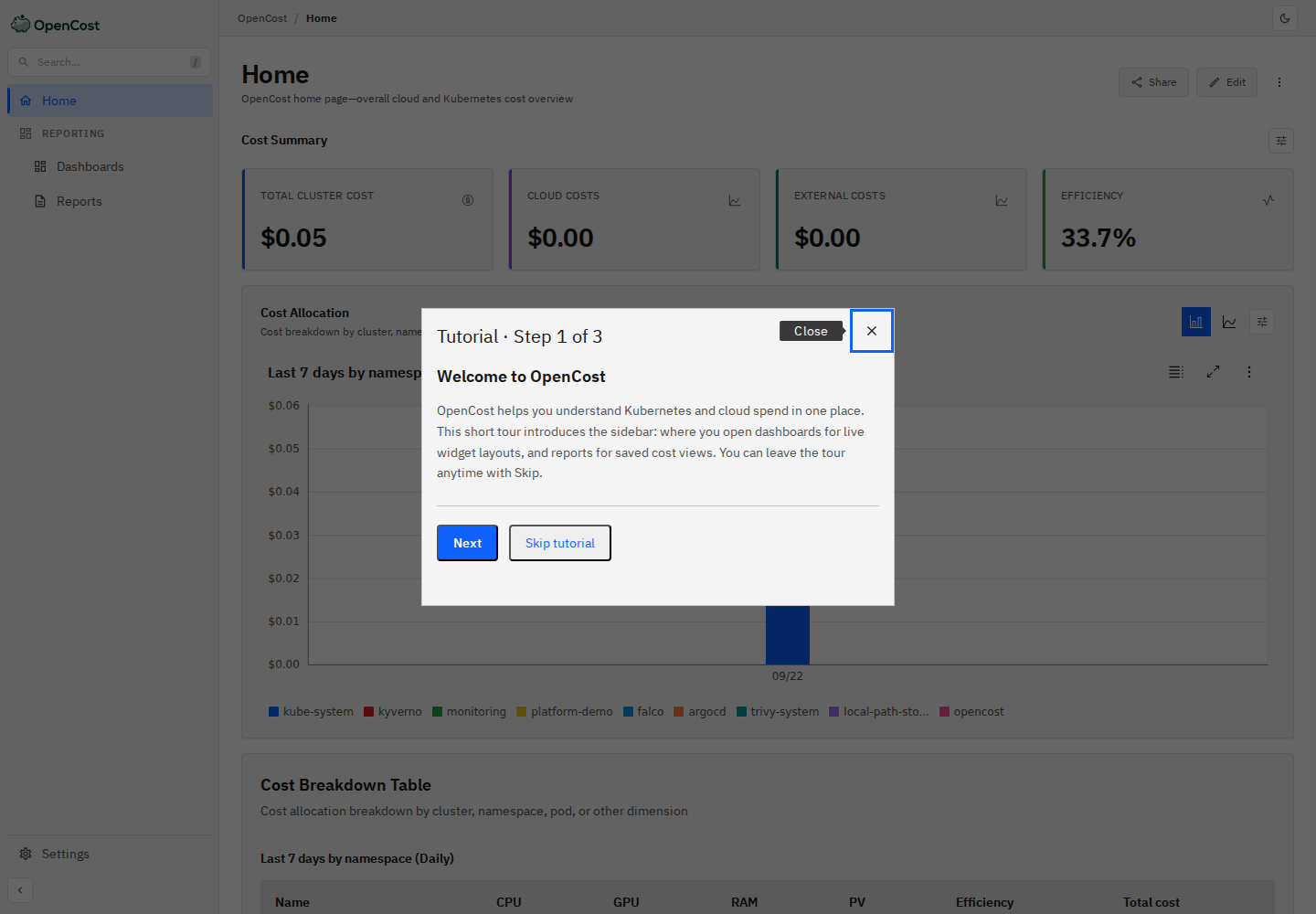
OpenCost successfully queried the in-cluster Prometheus service and returned live namespace allocation data. One 10-minute capture included:
platform-demo totalCost=0.00043000 cpuCost=0.00037000 ramCost=0.00006000
monitoring    totalCost=0.00084000 cpuCost=0.00057000 ramCost=0.00027000
opencost      totalCost=0.00013000 cpuCost=0.00007000 ramCost=0.00005000
Pricing boundary
The kind cluster has no AWS cloud-provider pricing identity. OpenCost's local/default model proves allocation plumbing and efficiency calculations, but these values are not AWS spend or an AWS bill.
Reproduce the read-only checks
With the local stack already running:
The helper refuses non-kind contexts by default. It performs read operations plus server-side dry-run admission requests; it does not run the destructive game day.
Still AWS-specific
The local runtime does not prove:
- GitHub OIDC assuming an AWS IAM role;
- S3/KMS Terraform remote state;
- an EKS control plane or managed node group;
- AWS load balancer/NAT/network behavior;
- AWS-specific OpenCost pricing;
- multi-region failover.
Those remain explicitly separated in the Live Activation Runbook.